Music should be owned like land, why the public domain may be a relic of an analog past, and a new way forward.
By Mark Frieser
There are few ideas in intellectual life as warmly regarded—and as insufficiently interrogated—as the public domain. For generations, policymakers have treated it as a necessary endpoint: a reservoir into which creative works must eventually flow, free for all to use. The rationale is familiar. Culture builds upon culture; innovation depends on access; the dead should not indefinitely bind the living.
Yet this orthodoxy rests on assumptions forged in a pre-digital world—one in which copying was costly, distribution was scarce, and the economic life of creative works was relatively short. Those conditions no longer apply. In an age where music can be reproduced infinitely at negligible cost, where data is harvested at scale, and where artificial intelligence systems are trained on vast corpora of creative output, the public domain may no longer be a benign commons. It may instead be a mechanism for uncompensated extraction.
At its core, intellectual property (IP) is a recognition of ownership over intangible assets: compositions, recordings, writings, inventions. But unlike physical property—land, buildings, vehicles—IP ownership is time-limited. Copyrights expire. Patents lapse. Eventually, the asset is stripped of its exclusivity and opened to unrestricted use.
This distinction is rarely questioned. It should be.
The Asymmetry of Ownership
Consider the treatment of real property. A parcel of land, once acquired, can be held indefinitely. It can be sold, leased, subdivided, or passed down through generations. Its owner enjoys not only the right to use it, but to exclude others from using it. This bundle of rights—exclusivity, transferability, and perpetuity—forms the foundation of modern economic systems.
Why then, should the fruits of intellectual labour be treated differently?
A songwriter may spend years crafting a work that generates value across decades—through recordings, performances, synchronisation in media, and now, algorithmic training datasets. Yet the law decrees that this value must eventually revert to the public, regardless of the creator’s wishes or the continued commercial utility of the work.
The justification for this limitation is often framed in terms of societal benefit. But it is difficult to see why society’s interest in access should outweigh an individual’s right to retain ownership of what they have created—particularly when the economic lifespan of creative works has expanded dramatically. A song released in the 1960s can today generate revenue through streaming, film placements, advertising, and derivative works in ways its creators could scarcely have imagined.
In contrast, no such forced reversion applies to physical property. A family home does not become public housing after 70 years. A car does not become communal transport after the death of its owner. These assets remain within the control of their owners and their heirs, subject only to voluntary transfer.
The discrepancy is striking—and increasingly untenable.
The Public Domain as Industrial Subsidy
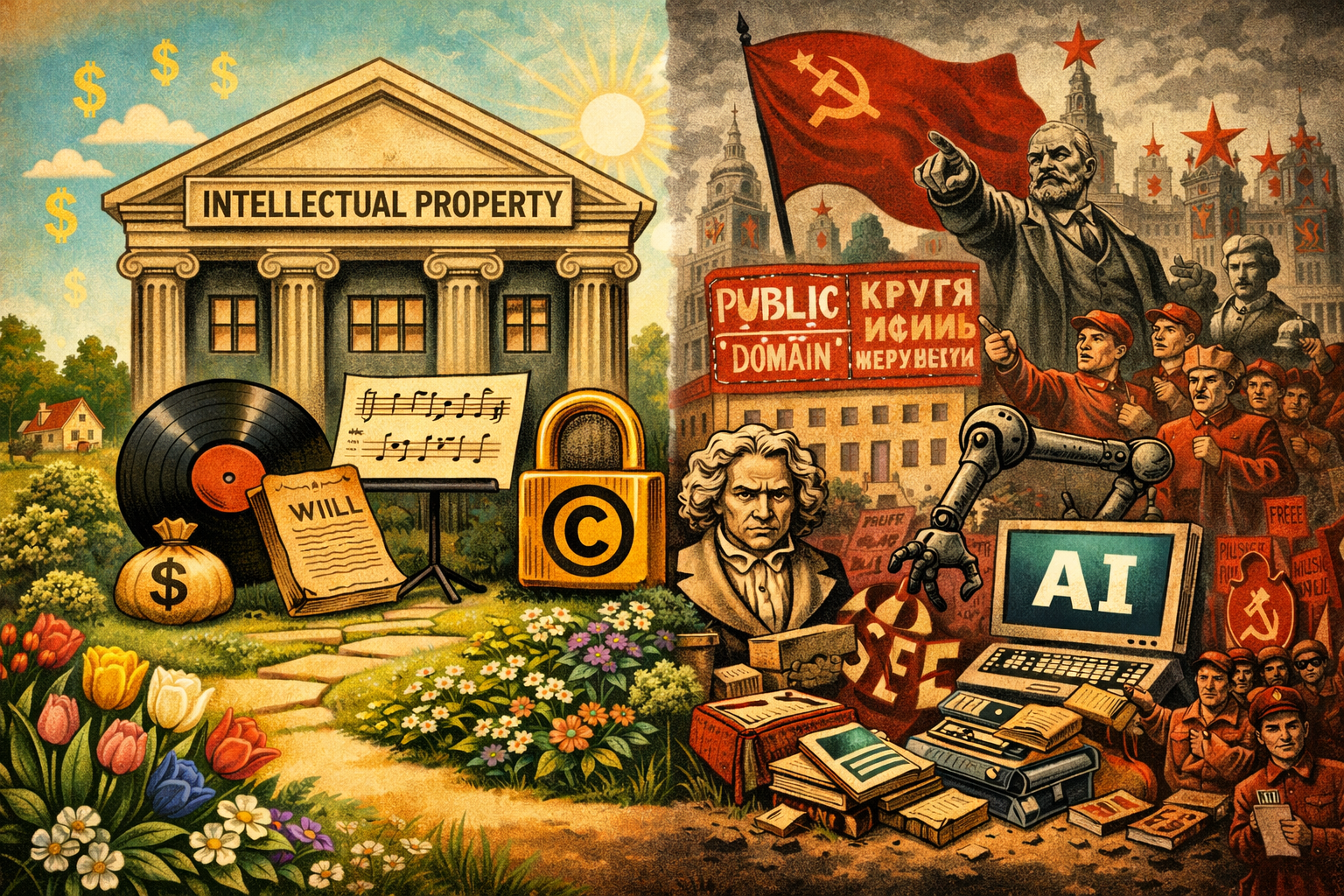
The modern defence of the public domain often invokes cultural enrichment. Shakespeare, it is said, belongs to everyone; Beethoven’s symphonies can be freely performed; old works inspire new ones. All true. But in practice, the beneficiaries of the public domain are not always artists or the public at large. Increasingly, they are large technology firms and content platforms.
In the era of artificial intelligence, public domain works serve as a vast, cost-free training dataset. Systems ingest music, literature and art without compensation to their original creators or their estates. What was once a philosophical commitment to cultural openness has become, in effect, a subsidy for industrial-scale data extraction.
The imbalance is stark. A property developer cannot simply appropriate land because its original owner has died. A manufacturer cannot use patented machinery without permission. Yet an AI company can train on decades—or centuries—of creative output with no obligation to compensate those who produced it.
This is not a neutral arrangement. It is a redistribution of value from creators to aggregators.
A New Property Paradigm
If the current framework is ill-suited to contemporary realities, what might replace it?
One possibility is to reconceptualise intellectual property not as a temporary monopoly, but as a form of property akin to real estate—subject to the same core tenets:
- Perpetual Ownership: Creative works remain the property of their creators (or their assigns) indefinitely, unless explicitly relinquished.
- Transferability and Assignment: Rights can be sold, licensed, or otherwise transferred without a government-dictated term, enabling markets to function efficiently.
- Inheritance: IP assets pass through estates in the same way as physical property, allowing families to benefit from generational wealth creation.
- Enforceable Exclusivity: Owners retain the right to control usage, reproduction, and derivative works, with robust mechanisms for enforcement.
Such a framework would not abolish access. Rather, it would shift access from being a default entitlement to a negotiated outcome. Just as land can be leased, easements granted, or developments licensed, intellectual property could be made available through structured agreements that balance access with compensation.
Importantly, this model aligns with the realities of digital distribution. Technology has already made it possible to track usage, manage rights, and distribute royalties at scale. The infrastructure for a more precise and equitable system exists; what is lacking is the legal architecture to support it.
Addressing the Objections
Critics will argue that perpetual IP rights would stifle creativity, locking away cultural building blocks and raising transaction costs. There is merit to this concern. Innovation often depends on recombination, and excessive fragmentation of rights can impede new work.
But the current system presents its own inefficiencies. Rights are frequently unclear, under-enforced, or exploited without compensation. Moreover, the assumption that creativity depends on free access to existing works underestimates the role of markets. Licensing regimes—if well designed—can facilitate access while ensuring that creators are paid.
Another objection is that perpetual ownership risks concentrating wealth among heirs rather than rewarding active creators. Yet this is no different from the treatment of physical assets. Societies have long accepted inheritance as a legitimate mechanism for wealth transfer, even as they regulate it through taxation and other means.
The question, then, is not whether IP should be subject to limits, but whether those limits should be as blunt—and as arbitrary—as they currently are.
From Commons to Contracts
The public domain was conceived in an era when scarcity defined distribution. Today, abundance defines it. The marginal cost of copying is near zero; the ability to monetise creative works has expanded globally; and the tools for managing rights have become increasingly sophisticated.
In such a world, the rationale for mandatory expiration of ownership weakens. What remains is a system that, however well intentioned, may no longer serve the interests of creators or indeed of a fair and efficient market.
Reimagining intellectual property as true property – durable, transferable, inheritable – would not eliminate cultural exchange. It would simply ensure that such exchange occurs on terms that recognise the enduring value of creative labour.
The public domain, long treated as a cornerstone of cultural policy, may in fact be an artefact of a bygone age. In the digital economy, where ideas are assets and data is capital, it is time to ask whether creators deserve the same rights over their work as owners do over their land.
If property is the foundation of capitalism, then intellectual property should not be its exception.