Operational AI’s Potential to Change Music Supervision for the Better
I’ve had a lot of meaningful conversations lately with my industry peers on how AI is going to evolve the craft of music supervision.
Some embrace it, others accept it, and some either reject it out of hand, hate it or fear it.
Whatever our thoughts and opinions negative or positive, AI is already a part of our personal and professional lives, and it will change everyone’s work, including that of music supervisors.
Regardless of what we do in the business of music for media, the key question we should ask is how can we harness AI to our benefit while being aware of and mitigating its downsides. And that starts with understanding it.
And, by understanding AI, its potential utilisations and implications, we’re able to better shape and apply it to help us to do our work more efficiently, to take over time-consuming, mundane tasks and free up more of our time for creative, strategic thinking and action.
So, what types of AI are there, and which aspects of AI should we embrace?
In a previous article, I mapped out the differences between the two types of AI: generative and operational.
Generative AI creates music, which companies like Suno and Udio being two examples. For music supervisors and the music for media business in general, most generative AI-created music is fraught with problems, including copyright infringement, legitimacy of music, and a generally negative perception in the industry.
This is because the AI of these systems were trained on other people’s creations without attribution or authorisation. And what this effectively means is that for sync purposes, any element of any song created by these systems is deemed unlicensable and unusable.
And while there are companies that have or are developing generative AI systems which are being trained ethically, meaning they have obtained permission to use the songs they train their AI, in practical terms, no legitimate music supervisor or company will use generative AI created music in their projects now or in the foreseeable future due to the negative perception and legal/reputational risk generative AI created music brings to a project.
Then there’s operational AI. Operational AI is the “good side” of AI. Ai that helps us to do mundane, repetitive tasks at scale, and it’s these operational AI services that have the potential to change the work of music supervision for the better.
With this said, the perception in the minds of many music supervisors and other people in the industry is that AI is bad in general because generative AI music services have poisoned the well for everyone good or bad, and it is up to us working with operational AI to help people understand the difference between generative and operational AI, and how operational AI can positively impact the work of music supervision.
I’m going to attempt this now.
How can Operational AI services help the work of music supervision?
Music supervision is a multi-faceted and complicated job. It involves creative strategy, research, an understanding of IP law and rights clearance, negotiation, project management, budget management, interpersonal management, music expert, marketing and storytelling.
Specifically, in the course of a project, a music supervisor will:
- Read scripts.
- Attend production meetings.
- Work with on-air talent.
- Understand creative objectives.
- Source music.
- Review submissions.
- Verify ownership information.
- Negotiate licenses.
- Coordinate approvals.
- Track budgets.
- Manage deliverables.
- Prepare cue sheets.
- Ensure rights compliance.
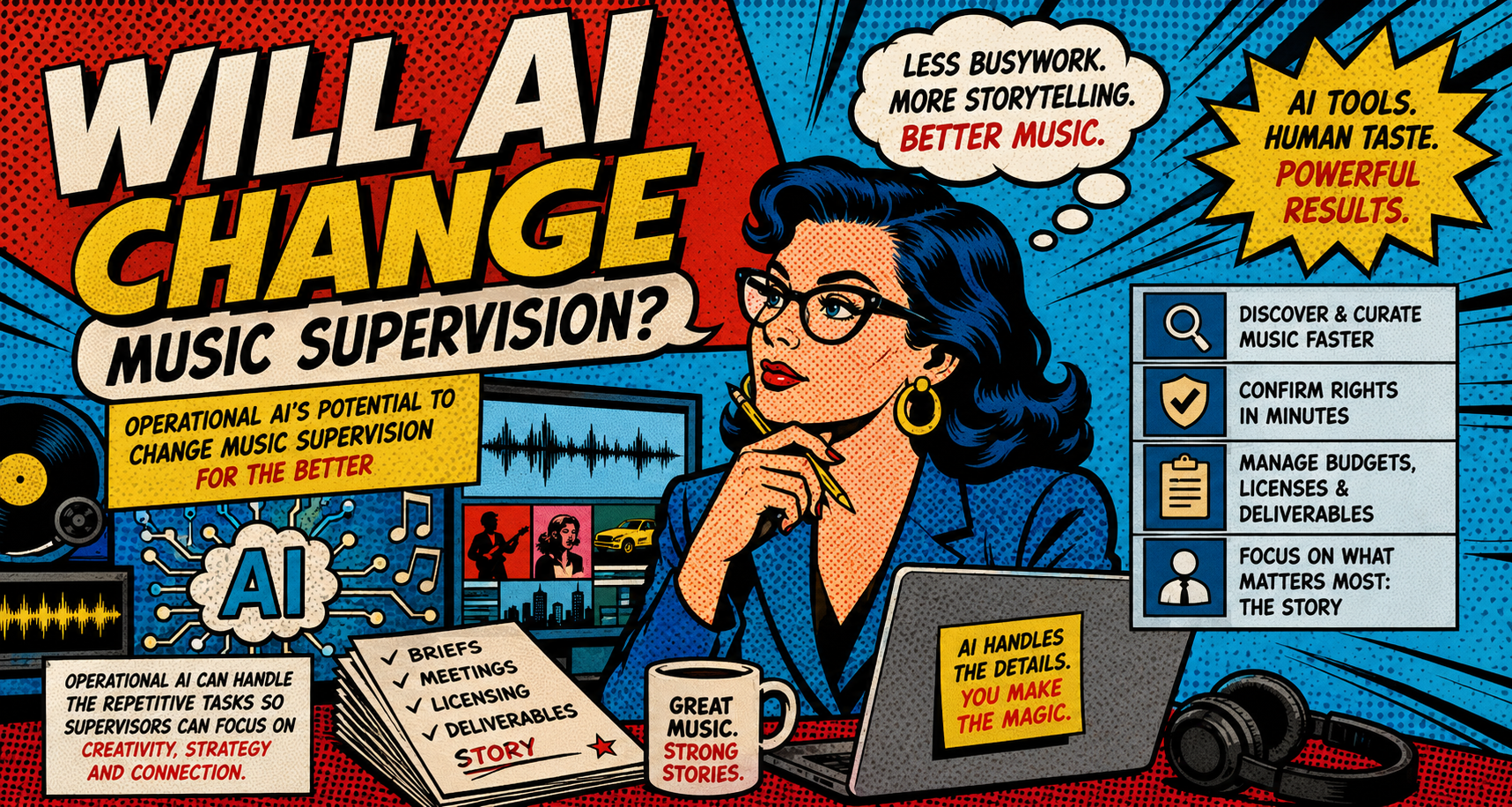
Many of these tasks can be assisted by operational AI, freeing up the time of the music supervisor to focus on the creative and production elements of their work.
Here’s some specific ways:
- Music Discovery, Review and Curation. AI systems that allow music supervisors to upload briefs, music references, videos and other types of information related to a music search can assist music supervisors to more quickly find music for their projects at greater scale and with greater accuracy.
There are systems coming to market that will allow music supervisors to quickly search for music for specific purposes from multiple sources at once, including music libraries, streaming services like Spotify, online systems like Bridge Audio and Disco as well as a music supervisor’s personal music libraries. Tools that help with music discovery and curation will provide music supervisors new, powerful ways to sift through billions of songs, saving them a great deal of time and energy they can devote to other elements of their work. - Rights Confirmation and Clearance. Alongside assessing the creative elements of music for their projects, music supervisors have to confirm and clear the legal ownership of the music used in their projects.
Sometimes the rights of a song are clear and the ownership certain, other times music supervisors have to spend an inordinate amount of time and energy to find the owners of sound recordings (masters) and who the writers and publishers are (composition and lyrics) of a song to clear it so they can then license it for their projects.
AI can be really helpful here. AI systems can help quickly find the underlying ownership structures, contacts, potential restrictions, and complexities surrounding the clearance of any song, reducing a research process which can take days to minutes.
Of course, the music supervisor will still have to confirm the rights information and the contacts needed to execute a deal, but the streamlining of this process AI can provide will be of real, practical value to every music supervisor, saving time, energy and money. - Budget, Deliverable and License Management. A good deal of the job of the music supervisor is a project management job.
The licensing process alone generates multiple documents per license, and each of these licenses has a corresponding budget line item which must be managed, and every piece of music used in a project has to be tracked throughout the production process. This includes everything from a budget spreadsheet, quote requests, licenses, cue sheets, invoices, payment scheduling and the organisation of contacts – it takes a lot of time and effort.
Again, AI can take on many elements of these processes, tracking and managing the budgeting, licensing and delivering of music for projects, ensuring cue sheets are populated and royalties as well as up-front fees are paid. This automates a lot of tedious process.
And though the music supervisor will still need to confirm and oversee these process elements, AI systems can greatly reduce the amount of time it takes to successfully manage and execute on these vital music supervision tasks.
Operational AI Will Allow Music Supervisors to Focus More on the Human Elements of their work.
AI’s ability to assist music supervisors in streamlining some of the key tasks I highlighted has the potential to elevate the work of the music supervisor, releasing them from the repetitive, time consuming work of discovery, clearance and management so they can focus on storytelling, evangelising music usage and music choices as part of their work in a production team and advocating for the creative elements of music in media.
Operational AI has the potential to empower music supervisors to do what they do best: looming music to picture to tell great stories, to sell product, to excite and delight people and to enhance experiences.
