Today, June 8th, at the Music Managers Forum Summit in NYC, I’m joining a panel of music tech peers to discuss one of the most important questions facing the music industry: Is AI friend or foe, and how do we protect creators in a rapidly evolving marketplace?
Successfully answering the quesiton of how we harness the upside potential of AI while mitigating its downside risk is crucial to the future of music.
As someone who’s worked in tech since the 1990s and music for media (sync) for over a decade, I’ve developed some pretty strong opinions on the subject. I believe that despite its distruptive nature, AI is a net positive for the industry. And, I believe if implemented and used ethically, AI is a fulcrum for greater productivity, creativity and music discovery.
With all this said, I want to zoom out and address one of the biggest misconceptions that people have about AI – which is what it actually is.
AI is not a monolith.
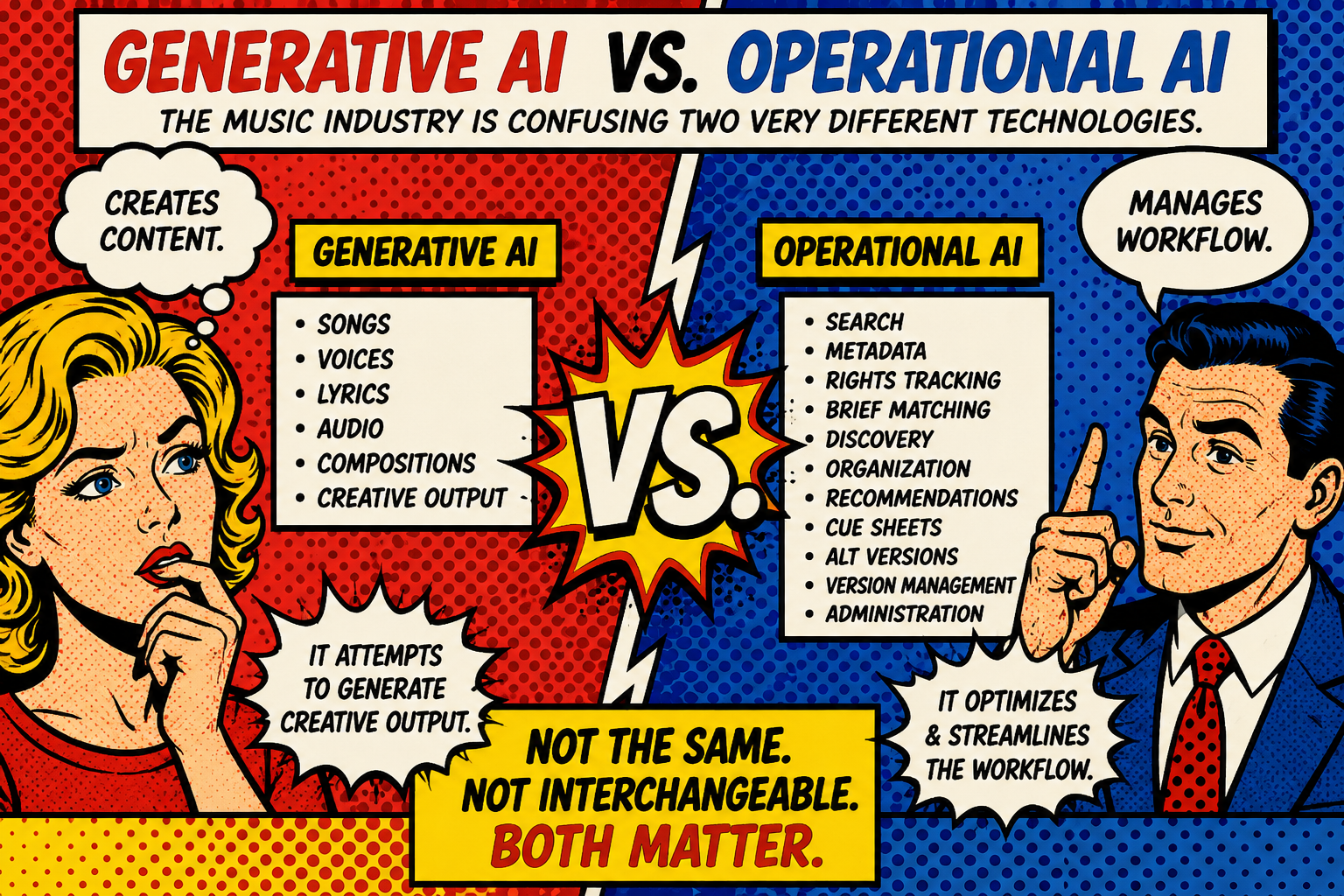
There are two types of basic technologies: Generative AI and Operational AI, and knowing the difference is crucial to understanding how you can use them effectively.
Here’s the difference:
Generative AI makes things: videos, songs, stems, compositions, pictures scripts and other forms of media.
Operational AI does things: it helps manage workflow, music discovery, metadata creation, refinement and confirmation, rights tracking, brief creation and music matching, organization, categorization and recommendation, administration and production.
Most people I know don’t know the difference between operational AI and generative AI, and when they say they hate AI or are afraid of AI, they usually are focusing on the downsides of generative AI without understanding the potential benefits of operational AI to their work.
The reality is that operational AI may ultimately create more opportunities for human-created music because it helps decision makers process, search, organize, and find music more efficiently and more accurately at greater scale with better metadata and clearability.
To give a few examples, a music supervisor trying to search through hundreds of thousands of tracks manually is not a sustainable workflow. An editor trying to find the correct instrumental version or stem set under deadline pressure is not an efficient process. A brand team attempting to navigate rights ownership across fragmented catalogs is efficient or economical.
Operational AI can help solve these problems.
And solving these workflow issues has the potential to help music become more discoverable.
As for generative AI, the fear surrounding it is understandable. Questions around ethics, licensing, compensation, training data, artist consent, and ownership are serious issues that deserve real discussion, which I’ll cover in a future post.
But operational AI is something else entirely.
The music industry has spent decades resisting workflow modernization. Metadata standards remain inconsistent or non-existent. Rights databases remain fragmented. Discovery remains inefficient. Search is still surprisingly primitive across large portions of the business.
Understanding the difference between generative AI and operational AI is the beginning of having a smarter conversation about where this business is actually heading.
If you want to learn more how AI is impacting our business, join us for the AI and Sync Symposium online and in-person on July 14th – click here for more details and how to sign up.