This is part of an ongoing series of articles on the usage of AI to assist everyone in the music for media business – if you are interested in leaning more about how AI is impacting sync, check out our upcoming event, the AI and Sync Symposium taking place at Pickle Studios in Brooklyn, NY on July 14th.
Yesterday, I joined three great music tech people for a panel at the Music Managers Forum Summit about harnessing the power of AI in music:
- Benji Rogers, Co-President of the AI-powered rights protection and monetization company Sureel.ai.
- Kristen Grant, Head of Communications, Marketing and Members at Pipeline, an AI-assisted company helping IP owners access capital.
- Michael Pelczynski, Chief Strategy and Impact Officer of Voice Swap, an company that utilizes AI to create vocals usage in music and voiceovers.
Most of the conversation centred on how AI could be used to help musicians and the people they work with to better monazite their music – including better ways to find music, to ascertain the way AI is trained with music and how that those (musicians, labels, publishers) can be better paid by the AI companies for the usage of their music in training AI system.
AI can help rights holders and creators get paid from their music in a myriad of ways, though some of these – like creating a way to pay out royalties to creators and companies for training materials (music) need buy-in from the generative AI companies.
This is something that in my opinion will call for a combination of enlightened thinking (and action) on the part of AI companies, new partnerships with rights holders and creators and ultimately, some sort of regulatory environment that put standards and practices in place to formalize payment methods and regimes between rights holders and generative AI companies. These things will happen in some form, but the actual implementations are still going to be worked out for some time, especially on the regulatory side.
Building a creator-friendly remuneration environment for the usage of music in training generative AI is crucial, but when I think about AI and its implementation in the music business, I believe it’s also important for us to focus on how we can use operational AI right now to help creators and rights holders connect with opportunities to get paid for their music… so let’s talk about that in terms of sync.
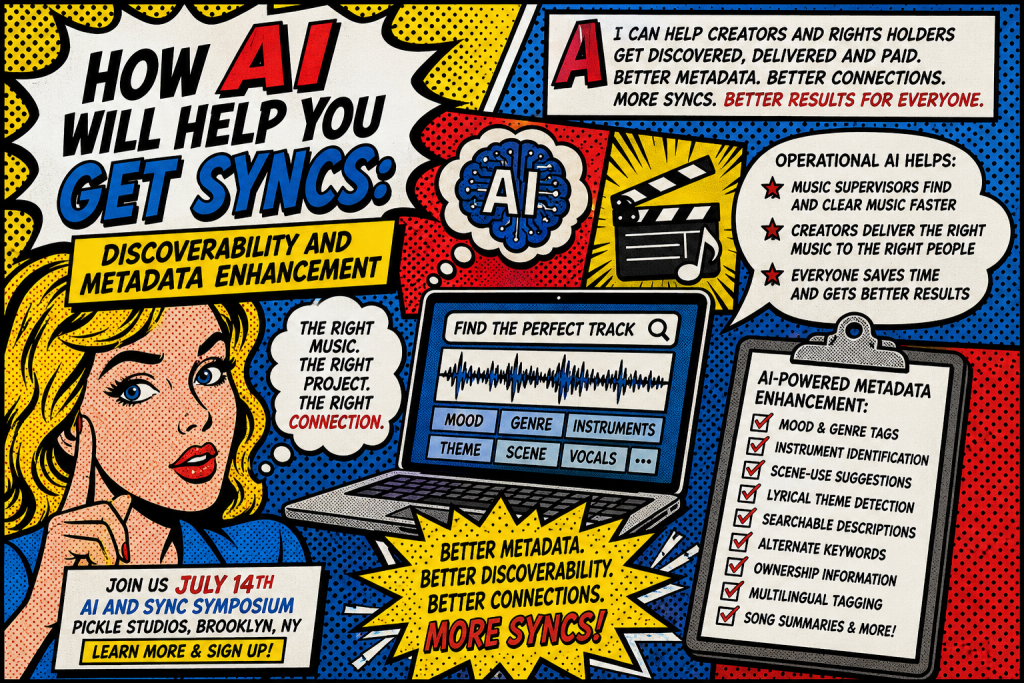
Specifically, how can AI help you get syncs? Well, there’s a lot that operational AI can do to help music supervisors find and clear music faster and better and allow music makers and right owners to better answer music requests and to promote music with better accuracy and results.
So let’s get into two specific use cases where operational AI can help.
1. Discoverability and Deliverability.
Music supervisors and other music for media decision makers are getting a constant barrage of music – music that they have asked for form specific people, music that are responsiveness to current briefs and general presentations and promotions of music from trusted sources and new people.
It adds up to thousands of pieces of music a week, and it’s an ongoing, almost impossible task to listen to everything but what is needed at the moment from trusted sources, and if absolutely necessary, from people or resources they haven’t worked with before. And beyond this, there’s the issue of music discovery beyond the music they receive. Every music supervisor to some degree explores new music beyond that sent to them – whether through AI prompts, word of mouth, events or research.
Just based on what I detailed, the creator and rights holder and the decision maker are not making efficient connections – there’s just too much music to go through and not enough time to do it.
Operational AI can help solve the issue of discoverability in some important ways: For the creators and rights holders, it gives you the ability to more accurately deliver music, with better metadata, at scale, whether for specific briefs or general pitches and presentations. It allows you to more precisely target how your music will resonate with a decision maker and their projects – saving you and the decision maker time and energy.
And for music supervisors and decision makers, the benefits are threefold. First, general music discovery searches and exploration scale better and are more accurate. Second, when they receive responses to a brief or they’re sent active pitches, operational AI allows them to better categorise and prioritise which songs are most relevant and most clearable for their projects. Third, music submitted to them for a brief or a pitch is delivered with more accuracy, saving the supervisor/decision makers more time and energy.
In short, operational AI solves for creator and music in media decision maker the issues of accuracy and time at scale, and this benefits everyone – music is better categorized, delivered, assessed and ultimately licensed.
2. Metadata Accuracy and Enhancement
Almost everyone’s metadata sucks. There I said it. It sucks. There’s no agreed upon standard, it’s incomplete and inaccurate, and this keeps decision makers from finding or listening to music.
Here’s why.
Bad metadata means you’re a problem child. One of the first things a decision maker does is look at a track’s metadata – most times before listening to music. And, if the metadata looks bad or inaccurate, it means that you’re setting them up with greater risk and wasted time if they want to clear your track. And then they move on to someone else who’s music looks more usable/clearable.
Bad metadata means your music is lost forever, never to be found. We rely on descriptive tagging to help us find music. So do AI tools. The better the metadata describing music, the better we are able to find it. And in most cases, the descriptions don’t have enough or accurate data that helps us locate what we want.
And though me and my industry peers have done a lot to evangelize and educate people to compile their metadata accurately and effectively, these efforts are at best are a drop in an ocean polluted with bad metadata. Despite our efforts, humans alone cannot solve the metadata dilemma.
This is where technology can help. Today’s operational AI systems can help us to enhance and enrich our metadata in a myriad of meaningful ways to:
- generate mood and genre tags
- identify instruments
- create scene-use suggestions
- detect lyrical themes
- generate searchable descriptions
- create alternate keywords
- organize catalogues
- identify missing ownership information
- suggest sync categories
- create multilingual tagging
- summarize songs for supervisors
- generate playlist groupings for specific use cases
And these and other metadata confirmation and enhancement tasks can be done by AI regardless of an organization’s scale, staff or catalouge size. The results are transformative and if implemented will directly lead to better, more accurate metadata, which means better finadability of and usage of music.
Ultimately, success in this industry comes from connecting your music and getting it heard by the right people, and operational AI can help us to categorize, discover and ultimately use music.
In short, artists, labels, publishers, and catalogs that integrate AI-assisted organization, discovery, metadata, and workflow tools into their businesses early have the potential to dramatically increase their chances of connecting with the decision makers and their projects.
If you want to learn more how AI is impacting our business, join us for the AI and Sync Symposium online and in-person on July 14th – click here for more details and how to sign up.
